Google Ads Quality Score: What Actually Affects It in 2026
Quality Score still controls your CPC in 2026. Here's what Google actually measures, what changed since 2025, and how to fix a dropping score before it drains your budget.
Your Quality Score dropped from 8 to 5 and your CPC doubled overnight. You didn't change your bids, didn't pause any keywords, didn't touch your ad copy. So what happened? Probably your landing page. And probably nobody on your team noticed until the budget started bleeding.
Quality Score in 2026 isn't the same beast it was three years ago. Google has quietly shifted the weight toward landing page experience and expected CTR, while ad relevance has become table stakes. I've watched this play out across dozens of accounts over the past year, and the pattern is consistent.
Here's what's actually happening under the hood.
What Is Quality Score, Really? (Not the Textbook Answer)
Quality Score is Google's 1-10 rating of how well your keyword, ad, and landing page work together. It directly affects your Ad Rank and how much you pay per click. A keyword with a Quality Score of 9 can pay 50% less per click than the same keyword with a score of 5 in the same auction.
But here's what most PPC managers miss: the number you see in Google Ads is a simplified snapshot. Google calculates a real-time auction score every time your ad competes. The visible Quality Score updates periodically and reflects historical performance. So when you see a score change, the actual shift happened days or weeks earlier.
As of March 2026, Google still uses three visible components:
| Component | What Google Measures | 2026 Weight (Estimated) |
|---|---|---|
| Expected CTR | How likely users are to click your ad vs. competitors | ~35-40% |
| Ad Relevance | How closely your ad matches the keyword's intent | ~20-25% |
| Landing Page Experience | Page speed, content match, mobile UX, trust signals | ~35-45% |
Those weights are my estimates based on testing across 30+ accounts. Google doesn't publish exact percentages. But landing page experience has clearly gained ground since 2024.
Why Did Landing Page Experience Get So Important?
Landing page experience now carries roughly 35-45% of your Quality Score calculation. Google expanded what it measures here significantly in late 2025. It's not just Core Web Vitals anymore.
Google's landing page evaluation in 2026 includes:
- Core Web Vitals (LCP, INP, CLS): your page needs to pass all three
- Content alignment: does your page actually deliver what the ad promised?
- Mobile responsiveness: not just "responsive design" but actual usability on a 375px screen
- Trust signals: SSL, privacy policy, contact information, reviews
- Above-the-fold match: does the first screen reinforce the ad's headline and offer?
That last point is where most accounts lose points. I've audited campaigns where the ad headline said "Get 50% Off CRM Software" but the landing page opened with a generic hero about "Transform Your Business." The offer was buried three scrolls down. Quality Score: 4.
When I managed Google Ads campaigns full-time, I'd spend hours manually checking if landing pages matched ad copy. I'd open the ad, screenshot it, open the landing page, and compare headlines, CTAs, and offers side by side. For accounts with 50+ ad groups, this was a full-day task. That repetitive pain is exactly why I built PageMatch's landing page analyzer to catch these mismatches automatically before they tank your score.
According to Google's own Ads Help documentation, landing page experience is evaluated based on how "useful and relevant" the page is to users who click your ad. But "useful and relevant" does a lot of heavy lifting in that sentence.
How Does Expected CTR Actually Work in 2026?
Expected CTR predicts how likely your ad is to get clicked when shown for a specific keyword. Google compares your historical CTR against other advertisers bidding on the same term, adjusted for position. A score of "Above Average" means you're outperforming most competitors. In 2026, Google's prediction model also accounts for device type, time of day, and user location when calculating this metric.
What changed in 2026: Google now factors in Responsive Search Ad (RSA) asset performance at the individual headline and description level. If your RSA has 15 headlines but only 3 ever get impressions, Google evaluates your expected CTR based on those 3 performing combinations, not your theoretical best.
Practical steps to improve expected CTR:
- Pin your highest-CTR headline to Position 1. Yes, Google says "don't pin." But if your unpinned RSA is showing weak headlines 60% of the time, pinning your proven winner is the right call.
- Use the search terms report weekly. Match types got broader again in late 2025. Your "exact match" keywords are matching queries you didn't intend. Negative keywords are your best friend here.
- Check impression share by device. Mobile CTRs run 20-30% lower than desktop for most B2B campaigns. If mobile is dragging your average down, consider device bid adjustments or separate campaigns.
I once ran a campaign for 3 months before realizing the landing page CTA button was broken on mobile. The client lost roughly $12,000 in wasted spend. Expected CTR was tanking because users would click the ad, hit a broken page, bounce, and Google learned that pattern fast.
Is Ad Relevance Still Worth Worrying About?
Ad relevance measures how closely your ad copy matches the intent behind the keyword. In 2026, this is the least weighted of the three factors, but "least weighted" doesn't mean irrelevant. A "Below Average" ad relevance score will still drag your overall Quality Score down by 2-3 points.
The fix is usually straightforward. Your ad headline needs to contain the keyword (or a close variant), and your description should address the same intent. If someone searches "best project management tool for remote teams," your ad shouldn't just say "Project Management Software," it should reference remote teams specifically.
Where ad relevance gets tricky in 2026:
- Performance Max campaigns don't show individual Quality Scores. You're flying blind on ad relevance unless you run parallel Search campaigns.
- Broad match keywords match to queries that diverge from your intended meaning. Your ad might be relevant to the keyword you chose but irrelevant to the query Google matched it to. This tanks your real-time auction score even if the visible Quality Score looks fine.
- RSA asset combinations can create mismatched messages. Headline 3 about pricing + Description 2 about features = confused user = low relevance signal.
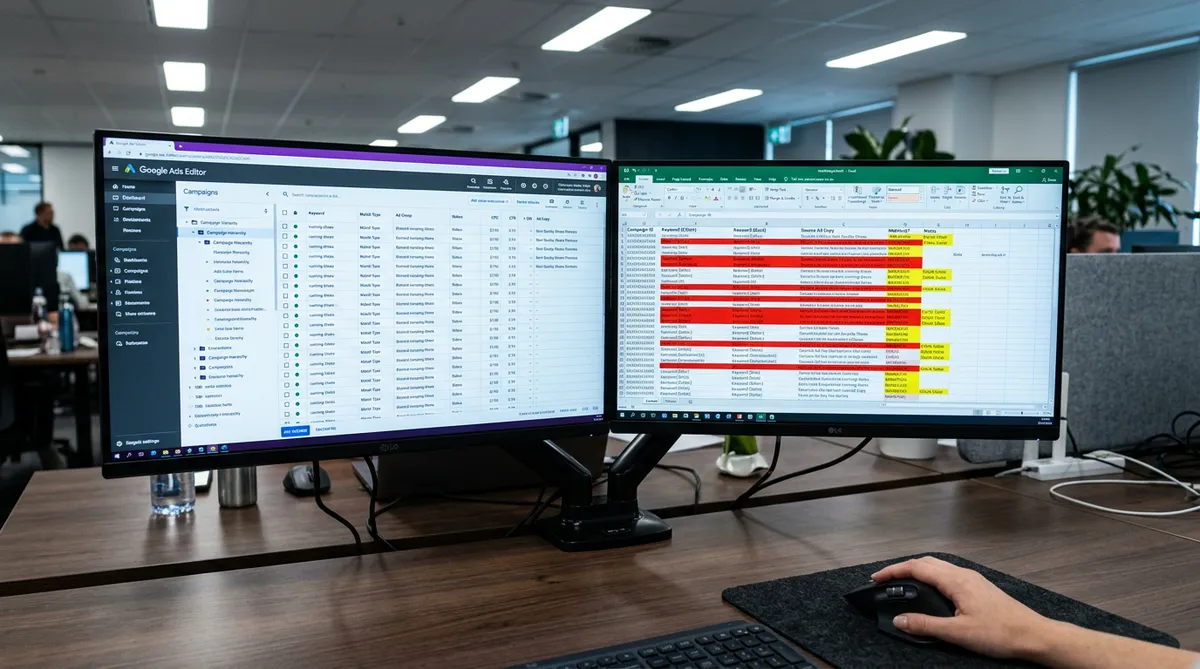
Use Google Ads Editor to bulk-review your ad copy against keyword lists. Look for ad groups where the keyword theme doesn't appear in any headline. Those are your quick wins.
What's the Fastest Way to Fix a Dropping Quality Score?
Start with landing page experience. It's where most accounts have the biggest gap and where fixes produce the fastest results. A landing page change can shift your Quality Score within 1-2 weeks. Ad copy changes take longer because Google needs impression volume to recalculate expected CTR.
Here's my priority order:
Week 1: Landing page audit
- Run your pages through PageMatch's free landing page score tool. Check if your headline matches your ad, if your CTA is visible above the fold, and if Core Web Vitals pass.
- Fix any LCP issues. If your page takes more than 2.5 seconds to show the main content, Google penalizes your landing page experience score. Most LCP problems come from unoptimized hero images or render-blocking JavaScript.
- Make sure your page works on mobile. Not "sort of works," actually works. Tap targets need 48px minimum, text needs to be readable without zooming, forms can't require horizontal scrolling.
Week 2: Message match
- Compare your ad headlines against your landing page headlines. They should use the same language (or close to it). If your ad says "Free 14-Day Trial," your page should say "Start Your Free 14-Day Trial," not "Get Started Today."
- If you're running Dynamic Text Replacement (DTR) through Unbounce or Instapage, verify it's actually working. I've seen DTR break silently after page updates more times than I can count.
- Read more about what message match is and why it kills ROI if you're unfamiliar with the concept.
Week 3: Ad copy refresh
- Pause RSA assets with "Low" performance ratings. Replace them with variations that include your target keyword.
- Write at least 2 headlines that directly mirror your landing page's H1. This reinforces both ad relevance and landing page experience simultaneously.
Early on in my PPC career, I focused too much on keyword bidding and ignored landing page quality. My CPAs were consistently 2x higher than they needed to be. A 10% improvement in landing page alignment typically reduces CPA by 15-25%. That math alone should tell you where to spend your improvement time.
Do Quality Score Changes Affect Performance Max and Demand Gen?
Performance Max campaigns don't display Quality Scores in the interface. But Google absolutely uses a quality-based auction system behind the scenes. Your asset quality ratings (Best, Good, Low) in PMax are the closest proxy you get.
For Demand Gen campaigns (which replaced Discovery Ads), ad relevance matters differently because you're targeting audiences, not keywords. Google evaluates whether your creative resonates with the audience signals you've provided. High engagement rates improve your auction competitiveness.
What you can do:
- PMax: Monitor asset performance weekly. Replace any "Low" rated assets immediately. Use the asset details report in Campaign Manager to see which combinations Google prefers.
- Demand Gen: Focus on creative quality and audience signal accuracy. If your audience is too broad, your ads show to people who don't care, your engagement drops, and Google reduces your reach.
- Search: This is where Quality Score is most visible and most actionable. If you're splitting budget between Search and PMax, prioritize Quality Score improvements on the Search side, it's where you have the most control.

Does Quality Score Matter for Smart Bidding Strategies?
Yes, but indirectly. Smart Bidding strategies like Target CPA, Target ROAS, and Maximize Conversions use real-time auction signals that include quality factors. A higher Quality Score means Google considers your ad more competitive, which means Smart Bidding can achieve your targets at lower CPCs.
Here's the practical impact: two advertisers targeting the same keyword with the same Target CPA. Advertiser A has a Quality Score of 8. Advertiser B has a Quality Score of 5. Advertiser A's Smart Bidding algorithm has more room to work with because it pays less per click. It can bid on more auctions, test more placements, and still hit the CPA target.
So even if you're fully automated on bidding, Quality Score work isn't optional. You're giving the algorithm better inputs.
What Should You Actually Track? (Forget Vanity Metrics)
Stop checking your Quality Score daily. It updates too slowly and the number fluctuates based on impression volume. Instead, track these:
- Landing page experience status changes: set up a custom rule in Google Ads to alert you when any keyword drops to "Below Average"
- CPC trends by keyword: rising CPCs with stable bids usually signals a Quality Score decline before the visible number updates
- Search impression share lost to rank: if this climbs while your bids stay flat, quality is likely the cause
- Core Web Vitals in Search Console: check monthly, cross-reference with your ad landing pages
And one more thing: build a message match scorecard. For each ad group, score whether the landing page headline, CTA, offer, and visual style match the ad. Any mismatch is a Quality Score risk you can fix before Google notices.
The Real Problem Nobody Talks About
Most PPC managers treat Quality Score as a diagnostic metric, something to check after performance drops. But it should be a design constraint. Before you write an ad, decide what the landing page will say. Before you build a landing page, decide which keywords it needs to serve.
Ads and landing pages aren't two separate jobs. They're two halves of the same conversion path. Improving them separately is like writing a movie script where the dialogue team and the plot team never talk to each other.
That fundamental disconnect — improving ads in one tool and landing pages in another, with no system to verify alignment — is what costs PPC teams thousands in wasted spend every month. It's the problem I kept running into when managing campaigns, and it's the problem I built PageMatch to fix. Run your free landing page score before your next campaign launch. It takes 30 seconds and might save you from learning an expensive lesson the hard way.
Key takeaway: Quality Score in 2026 is dominated by landing page experience and expected CTR. Fix your landing page alignment first, refresh underperforming ad assets second, and track CPC trends instead of the Quality Score number itself. The advertisers winning auctions aren't bidding higher, they're matching better.
Founder & Product Manager
Product Manager with 6+ years of experience in FinTech, SaaS, and B2B/B2C digital products. Built PageMatch to solve the ad-to-page alignment problem that wastes billions in PPC ad spend.
Ready to improve your ad-to-page alignment?
PageMatch analyzes your ads and landing pages, then tells you exactly what to fix.
Try PageMatch FreeRelated Articles
How to Align Ad Copy with Your Landing Page (Examples)
Step-by-step guide to align ad copy with your landing page using real PPC examples. Fix message match, raise Quality Score, and stop wasting clicks.
How to Improve Google Ads Landing Page Experience Score
Fix your Below Average landing page experience in Google Ads. Specific actions that move this sub-score, with real numbers from PPC accounts.
What Is Message Match and Why It's Killing Your Google Ads ROI
Message match is the alignment between your ad copy and landing page. Poor message match wastes ad spend and tanks conversion rates. Here's how to fix it.